Global Site


Company
Hankook Tire Kicks Off National R&D Project to Advance Sustainable Tire Manufacturing and Circular Economy
2026. 06. 09
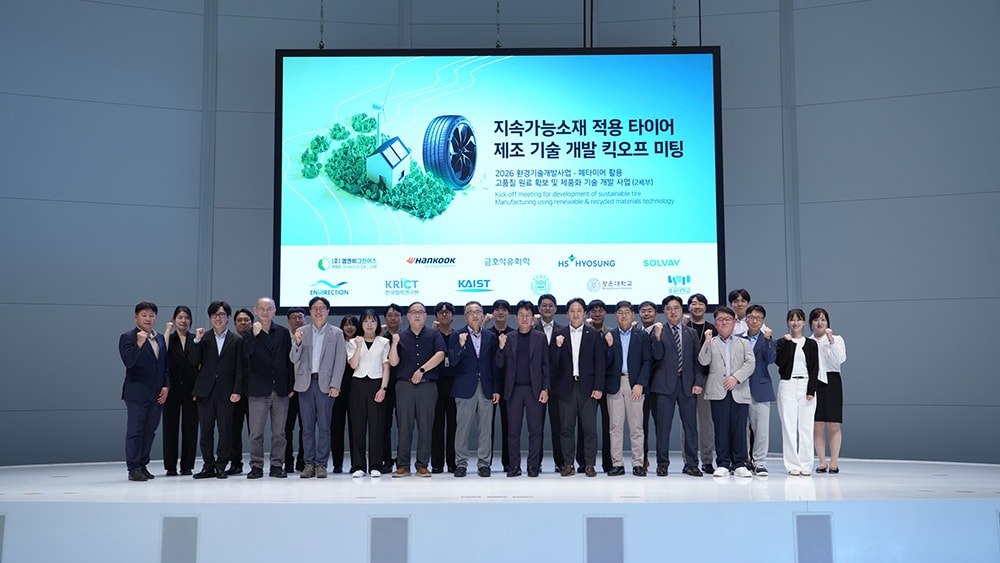
- Held a kick-off event at Hankook Technodome on June 4 with 11 industry, academic, and research organizations participating in a national environmental technology development program
- Expands the Tire-to-Tire circular economy model through participation in a government-backed R&D project following the launch of a private consortium in 2023
- Expected to diversify circular raw material sources and enhance technology validation infrastructure while mitigating global supply chain risks
Seoul, Korea, June 5, 2026 — A leading global tire company Hankook Tire & Technology (Hankook Tire) hosted a kick-off event on June 4 at its state-of-the-art R&D center, Hankook Technodome in Daejeon, for the national project titled ‘Development of Tire Manufacturing Technologies Using Sustainable Materials.’ The initiative is being carried out as part of the Ministry of Climate, Energy and Environment (MCEE)’s 2026 Environmental Technology Development Program.
The project seeks to accelerate Korea’s circular economy by securing high-quality recycled raw materials from end-of-life tires and advancing their commercialization in tire manufacturing. It consists of two key workstreams: the development of technologies for producing premium recycled feedstock from waste tires and the establishment of tire manufacturing technologies utilizing sustainable materials.
Since 2023, Hankook Tire has played a leading role in commercializing resource-circulation technologies through the launch of the industry-led Tire-to-Tire (T2T) consortium in Korea. The company also introduced the iON GT, a premium touring tire, under its EV-exclusive tire brand iON, containing more than 70 percent sustainable materials, to the European market.
Participation in the national project expands existing private-sector research into a broader collaborative ecosystem involving industry, academia, and research institutions. The effort seeks to reinforce responses to evolving environmental regulations while improving raw material supply chain resilience. Drawing on its experience operating the T2T consortium, Hankook Tire plans to expand the use of circular raw materials derived from end-of-life tires while proactively mitigating global supply chain risks through enhanced technology and validation infrastructure.
During the event, participating organizations shared their respective responsibilities and project roadmaps while exploring opportunities for future collaboration. The project is jointly carried out by 11 organizations, including lead institution M&B Green US, Kumho Petrochemical, HS Hyosung, HS Hyosung Advanced Materials, Solvay, Endirection, the Korea Research Institute of Chemical Technology (KRICT), KAIST, Pusan National University, Kwangwoon University, and Soongsil University.
Through the initiative, Hankook Tire aims to further enhance tire manufacturing technologies incorporating recycled and sustainable materials. The company targets the commercialization of next-generation low-carbon, high-performance tires containing more than 85 percent sustainable materials while reducing carbon emissions by over 50 percent. The project is also expected to facilitate large-scale verification of Korea’s Tire-to-Tire circular economy model through product demonstration and integrated performance assessment.
“This national R&D project presents a meaningful opportunity to bring together the expertise of leading industry, academic, and research institutions,” said Bonhee Koo, Head of the R&D Innovation Division at Hankook Tire. “Through close communication and collaboration among all participating organizations, we will strive to deliver tangible outcomes that contribute to strengthening competitiveness in the global market.”
Hankook Tire continues to expand the implementation of its Tire-to-Tire circular economy model. In April, the company participated in the launch event of the Eco-design Forum, where industry stakeholders exchanged views on response strategies to the EU Ecodesign for Sustainable Products Regulation (ESPR) and discussed key challenges related to sustainable product development.